

Travelling through Heathrow Airport becomes much easier when you arrange parking in advance. Choosing the right heathrow terminal parking - terminal 3 option helps passengers avoid delays, reduce travel stress, and enjoy a more convenient airport experience. Whether you are leaving for a short business trip or an extended holiday, understanding the available parking choices near Terminal 3 is essential.
Terminal 3 at Heathrow Airport is one of the busiest terminals, serving millions of passengers every year. Because of the high volume of travellers, finding convenient and secure parking can sometimes feel challenging. This is why many people prefer pre-booking heathrow terminal parking - terminal 3 to ensure availability and lower costs.
Parking near Terminal 3 allows passengers to save time and avoid the inconvenience of searching for last-minute spaces. Many parking facilities provide direct access or shuttle transport, making the airport transfer process smooth and efficient.
There are different parking options designed to suit varying travel requirements and budgets:
Short stay parking is ideal for quick visits, passenger drop-offs, or short business trips. These parking areas are located close to the terminal, allowing travellers easy walking access to departures and arrivals.
For passengers travelling for several days or weeks, long stay parking offers a more affordable option. Most long stay services include shuttle buses that transport travellers directly to Terminal 3, helping reduce walking distance and travel inconvenience.
Meet and greet parking is becoming increasingly popular among travellers seeking convenience. Drivers simply hand over their car near the terminal entrance, and trained staff park the vehicle in a secure facility. This option is especially helpful for families or passengers carrying heavy luggage.
Valet parking offers premium convenience by allowing passengers to leave their vehicle close to Terminal 3 without worrying about finding a parking space. It is often selected by business travellers or those looking for a faster airport experience.
One of the biggest advantages of pre-booking heathrow terminal parking - terminal 3 is cost savings. Parking prices can increase significantly closer to departure dates. Booking in advance often gives access to discounts and better parking locations.
Pre-booking also guarantees availability, especially during peak travel seasons when parking demand is high. Travellers can arrive at the airport confidently, knowing their parking space is already reserved.
Security matters when leaving your vehicle at an airport for several days. Trusted parking providers usually include:
CCTV surveillance
Secure fenced areas
Staff monitoring
Controlled vehicle entry and exit systems
These safety measures provide reassurance that vehicles remain protected while travellers are away.
Before confirming a booking, travellers should always consider an airport parking comparison to identify the best option for their journey. Comparing parking providers helps passengers understand differences in price, transfer time, location, and included services.
An airport parking comparison can also reveal hidden savings, promotional discounts, and customer-rated facilities that may offer better value than standard airport parking choices. Taking a few minutes to compare options often leads to a more affordable and convenient experience.
Selecting the right heathrow terminal parking - terminal 3 service can improve the overall travel experience. From short stay and long stay parking to meet and greet services, travellers have multiple choices depending on budget and convenience preferences. Before booking, completing an airport parking comparison is one of the smartest ways to find secure, affordable, and reliable airport parking for a smoother journey.
Hey everyone,
If you've ever tried to calculate total hours worked using separate native Time fields (Start Time & Finish Time) while deducting a Break (mins) number field, you know that SmartSuite's standard time functions are a bit restrictive.
If you want to keep your setup clean without forcing your team to use the combined Date/Time fields or the native time-tracking log, here is a workaround I discovered.
This formula forces SmartSuite to parse the underlying text string of the native Time Picker UI, converts it into 24-hour decimal math, subtracts the times, and automatically converts and deducts your break minutes.
I've attached a screenshot as reference for using this in a shift report or timesheet context.
A few quick setup notes for this to work:
[Start Time] and [Finish Time] are native Time fields (the formula automatically handles the backend string formatting and leading zeros from the Time Picker UI).
[Break (mins)] is a standard Number field.
Set your formula output type to Number (with 2 decimal places) to get clean results like 8.5 hours.
The Formula:
IF(OR([Start Time] == "", [Finish Time] == ""), NUMBER(""),
(
(
IF(CONTAINS([Finish Time], "PM"),
NUMBER(REPLACE(REPLACE(LEFT([Finish Time], 2), "12", "0"), ":", "")) + 12,
NUMBER(REPLACE(REPLACE(LEFT([Finish Time], 2), "12", "0"), ":", ""))
)
+ (NUMBER(REPLACE(LEFT(RIGHT([Finish Time], 5), 2), ":", "")) / 60)
)
-
(
IF(CONTAINS([Start Time], "PM"),
NUMBER(REPLACE(REPLACE(LEFT([Start Time], 2), "12", "0"), ":", "")) + 12,
NUMBER(REPLACE(REPLACE(LEFT([Start Time], 2), "12", "0"), ":", ""))
)
+ (NUMBER(REPLACE(LEFT(RIGHT([Start Time], 5), 2), ":", "")) / 60)
)
)
- IF([Break (mins)] > 0, [Break (mins)] / 60, 0)
)
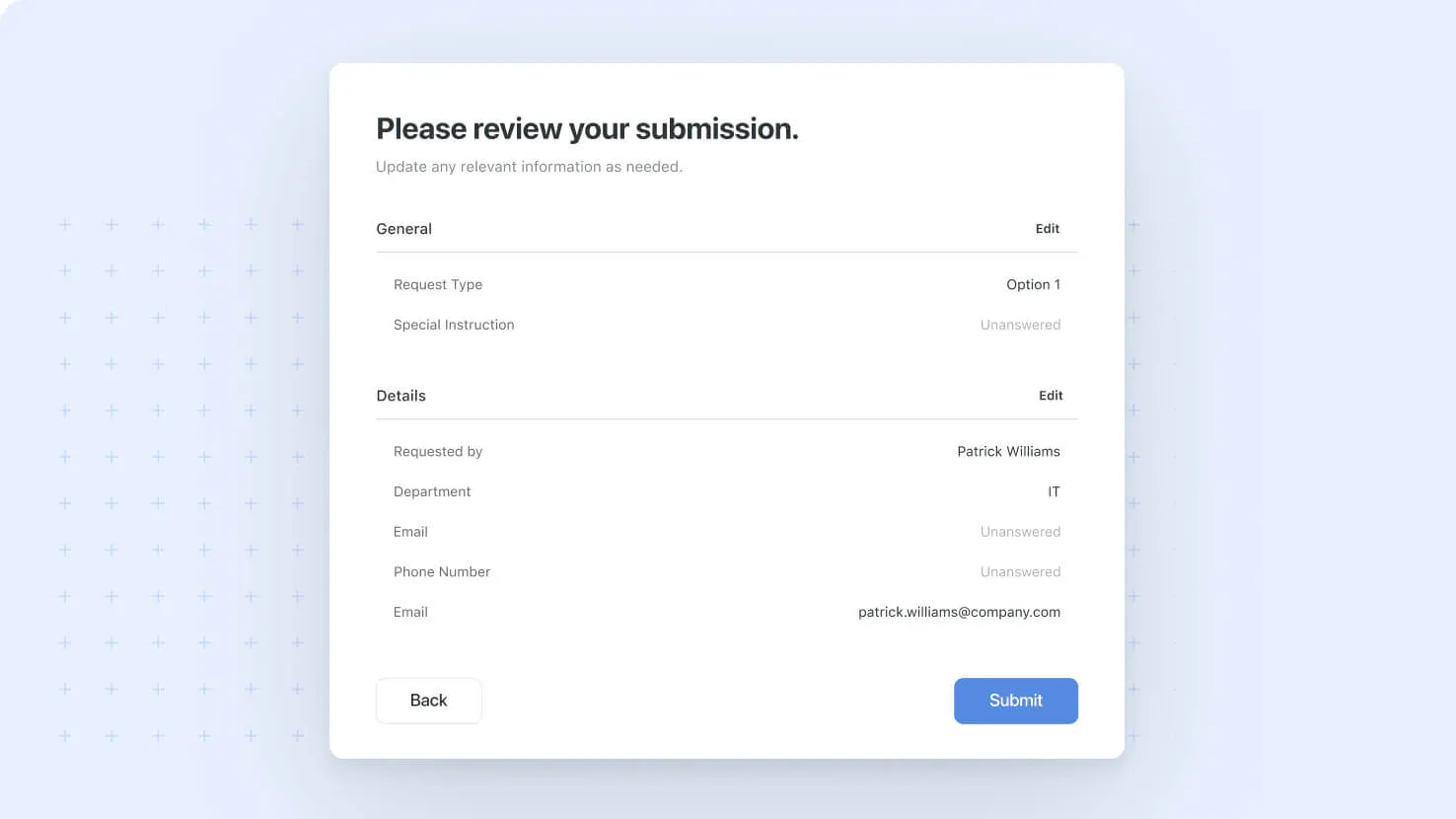
Multi-page forms now support an optional Review Page that lets users confirm their answers before submitting, with one-click edits back to any page. Service desk intake, compliance attestations, and any form with consequential downstream effects gets a built-in safety check at the end.
Key Highlights
Built-In Review Step: Add a single Review Page to any form to give users one last look at their answers before submission.
Page-Grouped Answers: Fields display grouped by the page they live on, with the page name as a heading and an Edit button to jump back.
Configurable Title and Description: Set custom copy for the review header, or use the defaults ('Please review your submissions' and 'Update any relevant information as needed.').
Per-Field Selection: Choose which fields appear on the Review Page; by default all form fields are pre-selected, including conditionally visible ones.
Smart Empty States: Unanswered fields show as 'Unanswered', Yes/No fields default to 'No', and fields with configured default values show their default rather than appearing empty.
How It Works
Add a Review Page from the Pages control at the bottom of the form canvas; one Review Page is allowed per form, and it always sits in a fixed position before the Submission Page.
Configure the Title and Description for the review header, both with translation support for the default values.
In the Fields to Review setting, deselect any fields you do not want users to confirm; everything else appears as a Label-Value pair grouped by source page.
When a user reaches the Review Page, they see all their answers and can click Edit next to any page name to navigate back, make changes, and return.
The Submit button only appears on the Review Page (or the last Form Page if no Review Page is configured), so users always know they are at the final step.
Use the Review Page wherever a submitter benefits from a confidence check before their answers commit, especially in service desk intake, compliance attestation, and structured onboarding flows.